
25.7: pour the wine

cw: genocides
There’s a place on the coast of so-called Oregon they call Cook’s Chasm, where the ocean rushes into a narrow channel and churns against itself, seeking an outlet it will not find. The surface froths in a way some might describe as rabid. When the tide is high enough, water rushes into a small cavern, quickly becoming more than it can hold, and shoots up and out from a small opening, spraying into the wind. A little further down is Thor’s Well, a hole in the rock which appears to suck the ocean into itself before bursting with overwhelm and releasing the water back toward the sky.
You can hike down and off the trail to stand at the water’s edge. At high tide, it is spectacular. The sound surrounds you; the spray will mist you so hard you walk away soaked. During a storm, it is dangerous to go near the chasm. The waves meet their match in the rock but still have to go somewhere. They will grow taller than all of it, taller than you, sweep you away, smashing into the crevice, turning you to pulp, your blood quickly blending with the brown of the bubbles.
It is easy to describe the sea as violent, but the sea is simply being a sea, driven by the winds and the gravity of the moon, continuing to move even in the face of the immutable. It expresses itself, because it must, even if the only place to put its energy is a hundred feet in the air.
It all has to go somewhere.
Returning from my grandmother’s funeral a couple of months ago, I stood at the edge of this chasm, seeking sublimation in the sound and sensation. My mind grasped for metaphors, then noticed all this naming took me away from the experience of being there. The ocean is bigger than my personal psyche. That’s why I need it.
I longed to un-name the place and strip it of projected meaning. It does not belong to an English sailor or a Norse god, to my childhood memories or my present feelings. It belongs to itself.
This place is more than the ocean or the stone or the tides or the storms or the winds. On the maps it is called Cape Perpetua, but before this, it was, and still is, Halaqaik, the “exposed place” where the Alsea people burned prairies, hunted, fished, and dug for clams along the abundant coast before the great British asshat James Cook came along and renamed it for a Christian saint, decimated the Alsea with smallpox, and forced survivors into a prison-like world called the Alsea Subagency, where many died from the horrific living conditions. By 1879, only 118 Alsea people were still living on their lands, but they were then swiftly removed to a reservation to make way for more white European settlers to claim their lands.
I watch the water roll in to the chasm named for this man, whose legacy was death, disease, and colonial domination, who was killed at last on February 14, 1779, by native Hawaiians after he attempted to kidnap their king and shot a protestor dead. The mighty waves feel small compared to the rightful rage felt around the world over all the life that this man took from this planet. I pray for his legacy to be smashed to pieces against these rocks.
When I am here, I want to experience it as deeply as I can without dying. I want to feel the fear. I step as close to the edge as I can before some internal gyroscope pulls me back. I imagine what it would be like for my body to be in this water, swirled and slammed by fast-changing water into slow-changing rock.
Then I imagine what it would be like for my body to be this water, and I remember that I already know.
I know what it is like to surge in a way I can’t stop, carried away by my own energy, summoned by forces larger and older than me, narrowed by the circumstances of this moment into a place I cannot not-go.
I have places in me that feel stuck, overwhelmed by energy. Sometimes I even churn against myself, becoming filthy and unclear, slamming into the edges and roaring louder the narrower things feel.
I am angry at the traumas that have shaped me in this way, creating walls of stone, eroding so slowly that any change feels imperceptible. I am angry at the forces of immense violence that have shaped the world and suppressed indigeneity and diversity and self-expression everywhere. I long ferociously to break through my inner walls and tear down systems of oppression. By any means necessary, at any cost. I continue to find that the outer work begets inner work, and demands it. I grow impatient with my own healing, frustrated, losing hope. I at least want to break free within myself. I work so hard at it. Why then these dead ends?
I felt this way today and told a wise friend, who asked me to describe the feeling in words. Instead, I sent her a video from the edge of the chasm.
“So much motion in the stuckness,” she observed.
The ocean is the ocean. All of it. It is powerful. And this narrow chasm where its only outlet is to shoot high into the air, like it’s a blowhole — this is a place of spectacular beauty, one I descend toward willingly, one I would feel lucky to see during a storm, when it is even more “out of control,” even less contained.
I don’t blame the ocean or call it violent. It’s doing what it has to do, in this place where it has nowhere else to go. The spectacular spray is a necessary expression under the circumstances.
It’s the same water as the water that grazes your toes gently a few miles away; in fact, this water was there, being that water, not so long ago, and the water that’s there now was here before and will return before long.
Maybe through observing the ocean we can begin to understand. Everything is connected. Love that cannot rage cannot be love.
Right now, I honor only two Greek “deities” as embodiments of energy I wish to cultivate: Eros, the god of passion, and Nemesis, the goddess of divine retribution.
Eros burns on my windowsill, reminding me that passion is gloriously unstable and that living in a way that feels fully alive requires me to accept the rise and fall, ebb and flow, crash and churn of constant change. There is no greater pleasure than when I can meet the moment as it is and not hold back awaiting certainty, which only arrives after the sliver-window of true possibility has passed. It is terrifying to practice this level of presence, and I rarely succeed to the degree I wish to, but it is a path to which I am deeply committed.
Nemesis watches over my space, a sword in one of their hands, imbalanced scales of justice in the other. She is here to right past wrongs because there is no other way to achieve justice, balance, or peace. Nemesis must be called upon, understood, and embodied in the places where great harm has been done.
For me, Eros and Nemesis are deeply connected. Erotic attraction feels like a move toward balancing something in the world that is deeply out of balance — the more wide the gap to be closed, the more satisfying the connection. Eroticism opens me to life, and relationship, which opens me to pain, which opens me to a deep awareness of injustice and a deep longing to make things right.
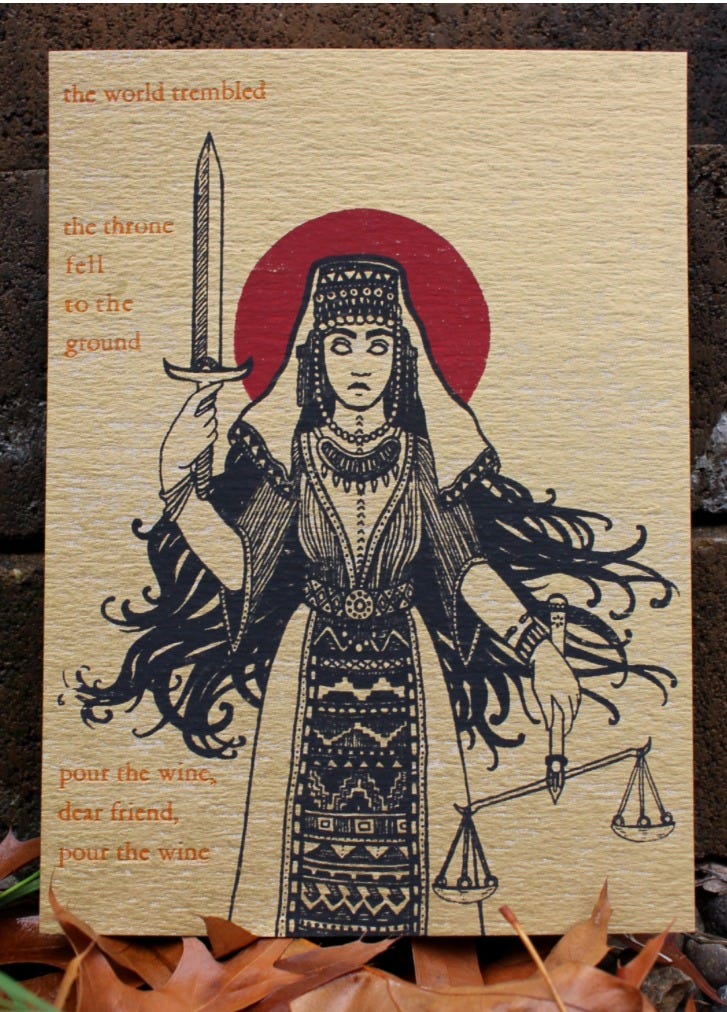
the world trembled, my print of Nemesis reads,

the throne fell to the ground

pour the wine, dear friend
pour the wine
These words are drawn from an Armenian revolutionary folk song, “Gini Lits / Գինի լից / Pour the Wine,” which celebrates the assassination of Talaat Pasha, the Ottoman official who in 1915 directed the genocide of Armenian people, who were already suffering from massacres and oppression, as well as various forced displacements within Ottoman-controlled territories.
His project began with deportations of Armenian intellectuals and community leaders, followed by death marches into the Syrian desert, mass rapes, the establishment of concentration camps, forced conversion to Islam, sexual violence, and other tactics common to genocide, including the assertion that it was necessary to kill them all. Talaat Pasha told the German newspaper Berliner Tageblatt:
We have been blamed for not making a distinction between guilty and innocent Armenians. [To do so] was impossible. Because of the nature of things, one who was still innocent today could be guilty tomorrow. The concern for the safety of Turkey simply had to silence all other concerns.1
Substitute “Armenians” for “Palestinians” or “migrants,” and “Turkey” for “Israel” or “America,” and we are squarely in 2025.
The horrors of the Armenian genocide cannot be overstated. Corpses lined the roads of deportation. Drowned bodies floated in the lakes, got stuck in the gorges. Officials sent corpses down the rivers, resulting in epidemics downstream. Children hid under corpses to evade capture. More than a million people died. Their homes were marked “abandoned” and given to Turks. And the whole of Europe knew what was happening, the whole time.
Those whose bodies survived endured unimaginable violence, including forced de-Armenianization. They were stripped of their names and culture, including their language. Women were taken into sexual slavery or else married to Muslim men. Children were likewise given to Muslim families and often exploited for sex and labor.
Many of the refugees who made it to the Russian-controlled territories that eventually became the Republics of Armenia and Azerbaijan still died there from illness, injury, or starvation, as the Turks destroyed their crops and blocked access to food.
These things were done to them not by some distant entity called “the state” but by the people who made these choices.
In response, Armenians fought back, including through an effort called Operation Nemesis. Seven of the genocide’s primary architects, including Talaat Pasha, were assassinated by revolutionaries.
And Nemesis joined the revolutionaries in dancing on their graves.
Rage, revenge, passion, desire, fury — these forces are magnificent. They not only have a place in this world, they have shaped this world and will continue to. Without them we are missing part of what it is to be alive, to be an ocean, to be humanity. Without them we are tamed, subdued, shut down.
I learned, for my own safety in this life, to suppress these feelings as much as possible, even if it meant denying myself presence, pleasure, creativity, connection, and magic. My capacity to be with the majestic and the overwhelming has ebbed back and forth like tides.
Without channels for expression, I have at times turned against myself or those closest to me. I have been frustrated by my ability to build glorious tension and then fumble the full expression. I sit on dozens of essays that I have been too afraid to publish until they are no longer relevant. I have bit my tongue and sat on my hands so many times that they often turn against me. I know I am not alone because the phrase “inner turmoil” is common, as is “in-fighting,” while real, flowing fervor is difficult to find in this world.
Perhaps this is why I am drawn to this chasm, this place where the rock has formed just so, where the immense tension created by the narrowness of the channel churns and changes — frothing as it enters, careening as the waves approach the dead end where they will come even more alive, swooshing into the cavern and then exploding into a vertical fountain of glory, the walls dripping with salty aftermath in its wake.
I place myself at this edge, knowing full well I could get caught in a sneaker wave. The risk is part of the thrill. I let myself be showered by a phenomenon indifferent to my presence. I slip off my shoes (not recommended for safety) and reach my toes into the stone, feeling for this place’s older name, the stories that churn underneath colonial frameworks and insufficient metaphors.
There is a bigger, older story, one we are all deeply woven into, one shaped over generations by mighty forces, one only our most powerful emotions can change.
Change, they will. Fall, all empires do. Pour the wine, dear friends. Pour the wine.
I encourage readers and listeners to learn more about the Armenian struggle, which is what led to the creation of the word “genocide,” including the 2023 invasion of the autonomous region of Artsakh by Azerbaijani militants, which resulted in a near-total displacement of its residents.
You can purchase the Nemesis print I referenced through Entangled Roots Press. One hundred percent of sales goes to All for Armenia to support refugees from Artsakh. You can also support All for Armenia directly.
Thank you as always for your support.
As transcribed in the Wikipedia article on the Armenian genocide from Stefan Ihrig’s Justifying Genocide: Germany and the Armenians from Bismarck to Hitler. This quote was given to a German newspaper, Berliner Tageblatt. Many believe that German support for the genocide of Armenians is https://en.wikipedia.org/wiki/Armenian_genocide